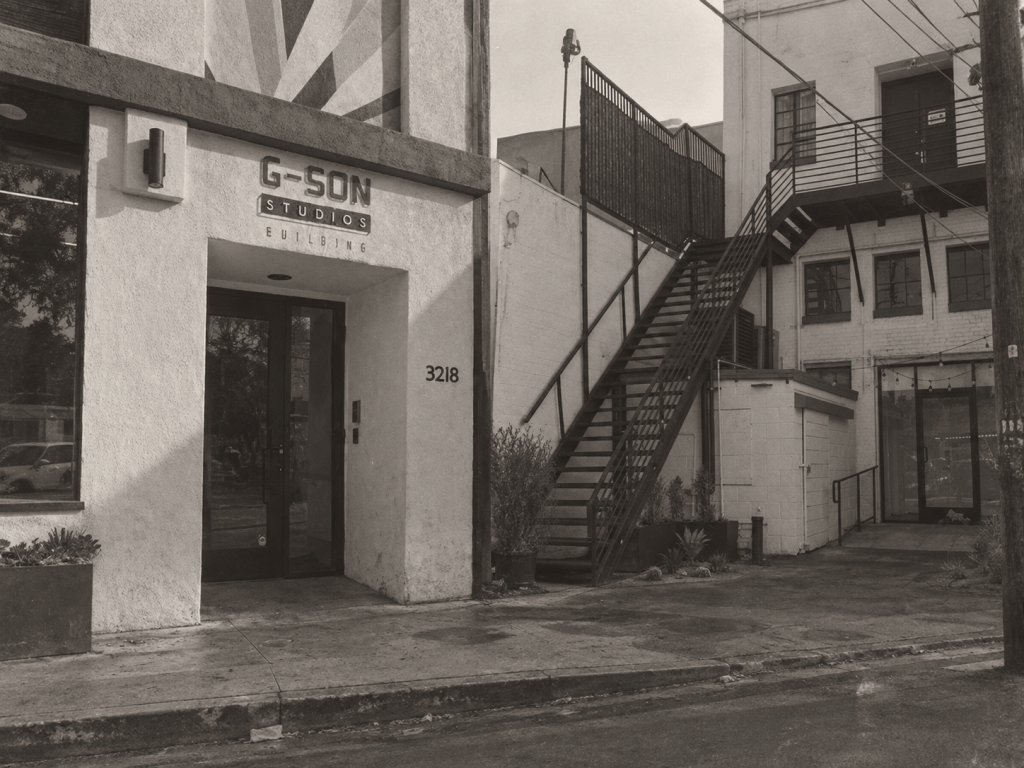
A former community ballroom, a pharmacy downstairs, a broken plumbing-shop sign, a basketball hoop, and one of the least conventional places imaginable to make Check Your Head. If you were looking for the place where the Beastie Boys would reinvent themselves after Paul’s Boutique, you probably would not have chosen the second floor of an old commercial building in Atwater Village, Los Angeles.
G-Son was not a famous recording studio and was not in the center of the Los Angeles music business. The space had once been a community-center ballroom. There was ordinary neighborhood retail below it. The Beasties could not even make much noise until the downstairs business closed. And when they moved in, it was not really a recording studio at all.
Their keyboardist/carpenter Money Mark Nashita had to build part of it. That improvised space became G-Son Studios, the creative headquarters where the Beastie Boys made Check Your Head, continued into Ill Communication. They filmed portions of the “Pass the Mic” video, developed the Grand Royal record label and magazine, played basketball, skateboarded, listened to records, invited friends over and gradually figured out what the Beastie Boys were going to become in the 1990s.
G-Son was unusual because it was not designed to make records. The Beasties made the building fit the way they wanted to record music.
FINDING A HOMEBASE
The path to G-Son began after Paul’s Boutique. The Dust Brothers-assisted album had involved extraordinarily elaborate sample construction and expensive professional studio work. Although the record would eventually become regarded as a masterpiece, commercially it initially fell far short of Licensed to Ill.
For the next album, Mario Caldato Jr.—who had engineered on Paul’s Boutique and would become central to the band’s next phase—saw a practical problem. Studio time cost money. A lot of money. And the Beasties were no longer working quickly enough for the conventional rent-a-studio-by-the-hour model to make much sense.
More importantly, they had started doing something that required time. They were playing instruments together again. Caldato has recalled that the process began informally in apartments and houses. The Beasties, Money Mark and Caldato would fool around with instruments, but neighbors eventually complained about the noise. They moved into rehearsal space and began recording ideas there.
Then Caldato proposed a more radical solution: Instead of continuing to pay somebody else for studio time, why not rent a cheap space and build their own? For the Check Your Head sessions, he remembered the Beasties renting an empty space and installing the equipment they needed: microphones and outboard gear that Caldato already had, plus a Neotek Élan console and a Tascam two-inch tape machine purchased for the studio.
The proposal changed much more than the band’s studio bill. It changed the way they could work.
GLENDALE BOULEVARD IN ATWATER VILLAGE
G-Son was established in an upstairs space at the corner of Glendale Boulevard and Larga Avenue in Atwater Village, northeast of downtown Los Angeles.
The present G-Son operation gives its address as:
3218½ Glendale Boulevard
Los Angeles, California 90039
Historical accounts sometimes use 3218 Glendale Boulevard or 3222 Glendale Boulevard. That apparent inconsistency largely reflects the multiple storefronts and units associated with the same commercial complex rather than three completely different G-Sons. The present venue identifies itself as 3218½ Glendale.
The neighborhood itself mattered. Atwater Village in 1990–91 was nothing like the fashionable version of Atwater that developed later. Glendale Boulevard was an older neighborhood commercial strip populated by pharmacies, restaurants, bakeries, repair and specialty businesses, and modest storefronts. It was away from the obvious centers of the record industry. That was part of its usefulness.
The Beasties did not need a glamorous studio address. They needed somewhere they could disappear and reinvent themselves.
BALLROOM BLITZ
The building’s upstairs room had a completely different life before the Beasties arrived. The current G-Son history identifies it as the former Atwater Community Center ballroom—a large gathering room rather than a purpose-built recording facility. That helps explain the peculiar physical character of the place.
The space contained a substantial open room, which was perfect for the Beasties’ purposes once they began using it not only for recording but for rehearsing, jamming and hanging around. It was not acoustically conceived by a studio architect; the room was intend for community.
That distinction became part of G-Son’s identity. Instead of squeezing themselves into the workflow of a professional studio, the Beasties could turn the ballroom into something closer to a clubhouse with recording equipment. And that is what they did.
MONEY MARK AIN’T HAVIN’ IT
One of the best details in the G-Son story comes directly from Money Mark. Mark was not yet simply “the Beastie Boys’ keyboard player.” He was working as a carpenter.
His introduction into the Beasties’ circle had itself involved carpentry: Mario Caldato has told the story of Mike D damaging the gate at the group’s earlier G-Spot house and Caldato bringing Mark in to repair it. Music entered the conversation, Mark started playing with the group, and eventually his keyboards became fundamental to their new sound.
When they found the room that became G-Son, those construction skills suddenly became very useful. In a 1998 SPIN oral history, Money Mark remembered that the Beasties were already trying to work on the record, so he hurried the construction of the control room. His wonderfully revealing description was:
“We were building and recording at the same time.”
That may be the perfect sentence for Check Your Head. The record and the studio were essentially developing together. There was no pristine facility waiting for them. They created the workspace as they discovered what kind of music they wanted to make inside it.
[end of Part I]

