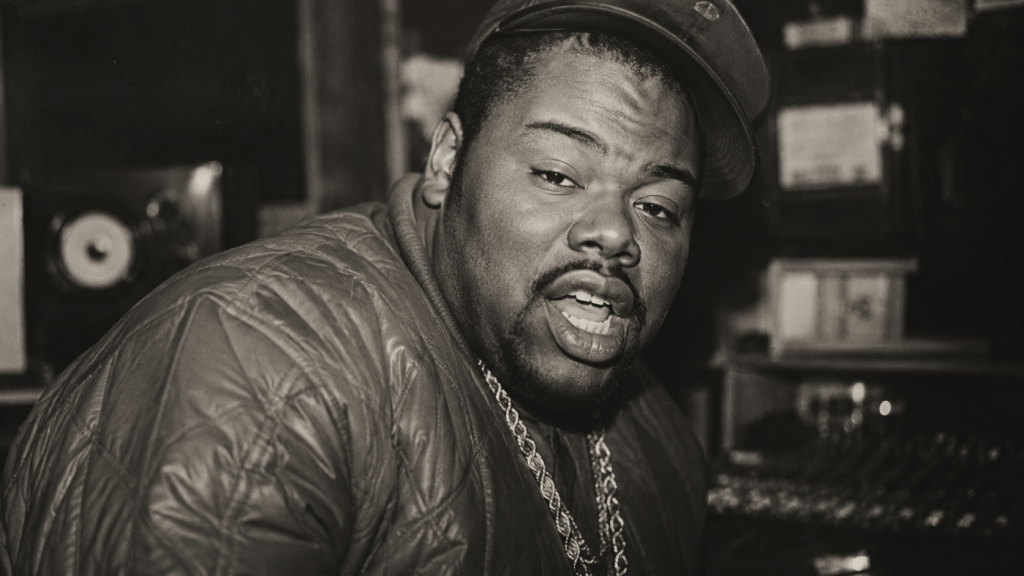
The familiar story begins with Biz Markie walking into G-Son Studios late at night and asking the Beastie Boys where he could buy candy. But Biz later suggested that he had met the group before that legendary visit. Untangling the competing versions reveals something larger: a friendship built on records, jokes, spontaneous performances, and Biz’s almost supernatural ability to turn collecting into mythology.
There is a perfect Biz Markie story about the first time he met the Beastie Boys.
It is late at night in Los Angeles. Biz arrives at the Beasties’ G-Son studio in Atwater Village, then a largely deserted commercial area. Almost everything nearby is closed except for a liquor store across the street. Biz’s first concern is not the recording equipment, the instruments, the basketball hoop, or the three famous musicians waiting inside.
He wants to know where the candy store is.
The Beastie Boys are confused. They briefly wonder whether “candy” is code for heroin or some other drug. It is around eleven o’clock at night, after all, and this visitor has arrived urgently requesting directions to a candy store. But there is no code. Biz simply wants candy. He goes to the liquor store, returns with a bag full of it, and proceeds to behave exactly as Biz Markie was expected to behave—except, as Ad-Rock later admitted, the Beasties had not anticipated that the real Biz would be quite so thoroughly Biz-like.
It is a wonderful story. It captures Biz’s appetite, innocence, eccentricity, and complete indifference to how a successful rapper was supposed to conduct himself. It also became the accepted account of how Biz Markie and the Beastie Boys met.
But it may not have been their literal first encounter.
Biz’s own version suggests that the relationship had a less cinematic prehistory. He remembered meeting the Beasties a little earlier, before they actually began spending time together. The surviving transcript of his 2017 Questlove Supremeinterview is machine-generated and badly garbles the name of the person who may have brought him to a studio, making it impossible to identify the intermediary confidently. Biz nevertheless made one distinction clear: he believed he had met them previously, but they “wasn’t hanging” yet.
That distinction—between encountering someone and truly meeting them—may be the key to the entire mystery.
The first encounter and the first real meeting
The evidence supports two different events.
First, Biz apparently had some kind of earlier contact with the Beastie Boys. He did not describe it as the beginning of the friendship, and the available transcript does not reliably establish where it occurred, who arranged it, or which Beastie was present.
Second, Biz came to the Beasties’ studio during the Check Your Head era and became part of the G-Son universe. This is the meeting everyone remembered because it was the moment the relationship came alive.
G-Son was ideally suited to Biz. The Beastie Boys had established the studio around 1990 in a former dancehall in Atwater Village. It was not merely a recording facility. The large room contained instruments, a basketball hoop, a skate ramp, and enough open space to function as a clubhouse. Artists could record, play ball, search through records, eat, argue, joke, or spend hours following an idea that might never become a proper song.
That environment matched Biz’s creative method. He did not always arrive with a written song or a formal plan. He arrived with records, fragments, memories, voices, sound effects, routines, and sudden demands that the musicians accompany whatever song had entered his head.
Ad-Rock remembered that Biz wanted to sing peculiar songs from the 1970s. He might ask whether the Beasties knew the Beatles’ “Yesterday,” then immediately begin singing before anyone had worked out the chords. According to Ad-Rock, the group accumulated a considerable amount of tape featuring Biz simply being Biz—improvising, singing, talking, and turning an ordinary studio visit into a performance.
Mike D remembered the same ritual. Biz would appear at G-Son, make the ceremonial trip across the street for a brown paper bag of candy, consume his sugar, grab a microphone, and announce a song as though the Beasties should already know how to play it. Strangely, they often did. On another visit, Biz brought a stack of 45s to make a tape for his flight home. Rather than filling it with celebrated breakbeats, he happily sang along to Helen Reddy’s “I Am Woman.”
The candy-store story, therefore, may not describe the first time Biz ever stood in the same room with a Beastie Boy. It describes something more important: the first time the Beasties experienced the full, uninhibited phenomenon of Biz Markie.
Which Beastie Boy met Biz first?
The honest answer is that no reliable published account identifies Mike D, MCA, or Ad-Rock as the first individual member to meet Biz Markie.
Ad-Rock tells the celebrated first-studio-visit story, but he speaks collectively about what “we” thought and did. That does not prove that he personally made the introduction.
Mike D supplied one of the most detailed accounts of the session that produced “The Biz vs. the Nuge.” In that version, the group stopped at Mike’s house and looked through records before continuing to G-Son. Biz examined sections containing Billy Joel, Paul Simon, and James Brown before pulling out Ted Nugent’s Cat Scratch Fever. That makes Mike a plausible early host or point of contact, but it still does not prove that he was the first Beastie Biz ever met.
Biz himself consistently referred to meeting “the Beastie Boys” as a group. His recollection of the earlier encounter is too garbled to determine whether one member was singled out. When describing the relationship that followed, he again spoke collectively: the Beasties were his brothers; they exchanged—or, in his joking formulation, stole—records from one another; he stayed with them, recorded with them, toured with them, and brought them to his favorite sneaker stores.
There are several theories, but none can presently be proven.
Theory One: All three met Biz during the first G-Son visit
This is the simplest reading of the Beasties’ collective account. Biz arrived at their studio, asked for candy, and encountered the group together.
The weakness is Biz’s statement that he had met them a little earlier. The G-Son story may have been the first significant hang rather than the first introduction.
Theory Two: Mike D was the initial personal contact
Because Mike’s account places Biz at his house looking through records before they went to G-Son, it is possible that Mike was the first member to spend substantial one-on-one time with him.
But the story may describe a later visit rather than the first. Biz eventually became a regular presence around the group, and memories of separate candy runs, record sessions, and improvised performances may have blended together.
Theory Three: They crossed paths earlier through New York’s hip-hop network
Biz and the Beastie Boys moved through overlapping New York circles during the 1980s. Fans have speculated that the connection could have come through LL Cool J, Def Jam, Rush Artist Management, or another shared figure in the city’s relatively compact hip-hop community. An online Beastie Boys discussion, for example, proposed LL Cool J as a possibility. No firsthand account located for this article confirms that theory.
The theory is plausible in a general sense. Biz knew nearly everyone. He had performed and worked with artists connected to the Juice Crew, crossed paths with Def Jam artists, and had an extraordinary habit of locating people and inserting himself into their lives. But plausibility is not documentation.
Theory Four: There was no single identifiable “first meeting”
This may be the most likely explanation.
Artists frequently crossed paths backstage, in studios, at clubs, on radio programs, and through mutual friends without recognizing the moment as historically important. Biz may have casually encountered one or more Beasties in New York and later reintroduced himself in Los Angeles. The candy-store night became the official origin story because it was memorable, funny, and unmistakably marked the beginning of the friendship.
Until a clearer firsthand account surfaces, assigning the first handshake to Mike D, MCA, or Ad-Rock would be speculation.
Basketball, Money Mark, and “Bennie and the Jets”
Biz remembered the beginning of the real friendship as a combination of basketball and music.
In his Questlove Supreme account, Biz described a game involving himself, the Beastie Boys, and what the imperfect transcript appears to identify as members of Boo-Yaa T.R.I.B.E. Biz, unsurprisingly, remembered himself fouling people. After the game, the gathering moved toward the piano and keyboards, with Money Mark helping turn the hang into a jam session.
Money Mark began playing songs Biz remembered from childhood. Biz knew them all and sang along. He moved freely through rock and pop records that many rappers of the period might have regarded as corny, unfashionable, or outside the acceptable canon. Then Mark played the opening of Elton John’s “Bennie and the Jets.”
Biz began singing.
The Beasties asked him to do it again. Then again. What might have begun as a joke continued for hours and eventually became a recording. Biz’s gloriously unstable version was released as a flexi-disc with the second issue of Grand Royalmagazine and was later included on the Beastie Boys’ The Sounds of Science anthology.
The performance explains why Biz fit so naturally into the Beasties’ world.
Neither Biz nor the Beastie Boys treated the borders between “cool” and “uncool” music as permanent. Biz could recognize an obscure drum break, treasure a soft-rock single, imitate a commercial, sing Elton John, perform a Beatles song, and beatbox within the same evening. The Beasties, particularly during the transition from Paul’s Boutique to Check Your Head, were similarly dismantling boundaries between rap, punk, funk, lounge music, jazz, dub, and childhood pop culture.
Biz did not need to adjust himself to their eclecticism. He was already living inside a musical universe in which every record, television theme, advertising jingle, toy, cereal box, sneaker, and half-remembered chorus remained available for reuse.
“The Biz vs. the Nuge”
The story behind “The Biz vs. the Nuge” is almost a miniature version of their entire friendship.
According to Mike D’s account, Biz was going through records at Mike’s house when he found Ted Nugent’s Cat Scratch Fever. He asked to bring the album to G-Son because he had an idea for it. Once at the studio, Biz made the customary inquiry about candy. A supply was obtained from across the street. The Nugent record went onto the turntable, and Biz completed his contribution in two takes.
The resulting piece lasts only about half a minute. Biz sings and vocalizes over the opening of Nugent’s “Home Bound,” transforming a ponderous 1970s guitar riff into a strange ceremonial announcement for the Beastie Boys. “The Biz vs. the Nuge” appeared on Check Your Head, released in 1992, with Biz credited as a guest performer.
Biz remembered developing the idea independently, calling the Beasties, playing the Nugent record over the telephone, and telling them he had something for them. However the exact chronology is reconstructed, the essential method remains the same: Biz heard a forgotten or unfashionable piece of popular culture, imagined himself inside it, and delivered the idea to his friends with total conviction.
That conviction was contagious. The Beasties did not need Biz to provide a polished composition. They understood that his spontaneous reaction was the composition.
From collaborator to brother
Biz’s relationship with the Beastie Boys continued well beyond Check Your Head.
He appeared on “Do It” from 1994’s Ill Communication and contributed to the Beasties’ broader 1990s recording world, including appearances associated with Hello Nasty. His “Bennie and the Jets” performance became a recurring favorite, and the group sometimes brought him onstage to sing it.
The influence also extended beyond individual songs. Mike D explained in a 1992 interview that Biz had a phrase he used when playing an especially good record: “Grand Royal, guaranteed!” The Beastie Boys adopted Grand Royal as the name of their label and magazine, meaning Biz’s private record-appraisal language became part of the institutional identity of the Beasties’ next era.
Biz described the relationship as a brotherhood. He believed he supported the Beasties during a period when parts of the hip-hop industry had become indifferent or hostile toward them after their split from Def Jam. In return, he said, they helped him understand business and the importance of saving money. Biz took the Beasties sneaker shopping; they introduced him to other things. Records moved back and forth, although perhaps not always with the original owner’s full consent.
Ad-Rock jokingly remembered that Biz kept a rare Funkadelic record and never returned it. An old friend was also reportedly still waiting to be paid for a boxed Rock ’Em Sock ’Em Robots set that Biz acquired. Ad-Rock initially called the record incident theft, then corrected himself: Biz had not exactly stolen it. He had simply kept it.
That correction describes the Biz Markie theory of ownership remarkably well.
Biz Markie, owner of everything
Biz was not merely a collector. He was a collector who made collecting sound like an occult power.
He claimed to possess records other collectors had never seen, machines that had never officially reached the market, toys in impossible quantities, vintage clothing, old videos, sneakers, dolls, board games, model cars, and artifacts connected to hip-hop history. His collections reportedly spilled into storage spaces and additional houses. Questlove credited—or blamed—Biz for inspiring his own enormous accumulation of records and popular-culture objects.
Some of Biz’s collection was undeniably real. Photographs, interviews, friends, and documentary footage confirm that he amassed records, sneakers, toys, dolls, vintage electronics, clothing, cars, and memorabilia. Director Sacha Jenkins described him as a lifelong “big kid” who collected random toys, Barbie dolls, and sneakers long before such collecting became a mainstream adult industry.
But Biz rarely stopped at saying he owned many examples of something. He tended to make the claim absolute.
He told The Washington Post that he had “every Barbie that ever came out.” He proceeded to display or name items including a Six Million Dollar Man figure, a Paralympic Barbie, Welcome Back, Kotter dolls, the Fonz, and figures from The Munsters. He explained the emotional origin of the collection simply: when he had wanted those things as a child, he could not get them. As an adult with money, he could.
The claim to own every Barbie is probably better understood as Biz language than as an audited inventory. It conveyed scale, obsession, and authority. Biz did not have a Barbie collection. In his telling, he had completed Barbie.
The same pattern applied to records.
The bell-less “Mardi Gras”
The most famous example of Biz’s collector mythology concerned Bob James’s “Take Me to the Mardi Gras,” the 1975 recording whose opening percussion became one of hip-hop’s foundational breaks.
Biz claimed to own a version without the familiar bells—essentially the drums and shakers stripped of the element most listeners associated with the recording. He said he had possessed it since the 1990s and described it as something like an acetate or discarded test version.
Questlove and other elite collectors searched for it. They could not find another copy. The pursuit became an expensive obsession. Questlove joked that Biz’s claim had sent collectors into a financial tailspin: while searching for the impossible record, they bought countless other records along the way.
Bob James disputed the story. He said there would have been no reason to make a version without the bell part and rejected the idea that Biz had somehow obtained an alternate master.
Biz remained unmoved. He argued that mistakes, acetates, abandoned masters, and unusual pressings existed. His defense culminated in a perfectly Biz-like statement: “I have no reason to lie about one record.”
Of course, the humor lies in the phrase one record. Biz had built an entire persona around possessing records that no one else could locate. During the same conversation, Questlove estimated that he owned approximately fourteen true one-of-one records. Biz replied that he had perhaps two or three thousand records he had never seen anyone else possess.
The bell-less “Mardi Gras” has never been publicly authenticated. But complete verification may be beside the point. The story transformed the record into hip-hop’s equivalent of buried treasure. Biz’s ownership claim made the object culturally valuable even if no one else could hear it.
He did not merely collect rarity. He created it through storytelling.
The Technics turntables no one else could get
Biz told a similar story about a pair of miniature Technics turntables designed to play 45s.
According to Biz, Technics had developed the machines during the 1980s but abandoned them when compact discs began taking over the market. Years later, while visiting Japan in connection with Yo Gabba Gabba!, Biz said he was brought into a factory, saw the forgotten turntables sitting in a corner, and arranged a series of trades to obtain them.
Unlike the bell-less “Mardi Gras,” the turntables appear to have physically existed; people had seen Biz use or display them. The uncertainty concerns the surrounding origin story: Were they truly unreleased prototypes? Was Biz the only private owner? How exactly did a children’s television appearance lead him into a Japanese factory where the machines happened to be waiting?
With Biz, a genuine artifact could acquire a layer of folklore almost immediately.
When asked what he would rescue if his collection caught fire, Biz selected both of the turntables—one with a curved tonearm and one with a straight arm—along with a beatbox machine he said Grandmaster Flash had given him.
The answer reveals that Biz did not value objects only for their market price. He valued provenance, exclusivity, personal history, and the story he could tell while showing the object to someone else.
Buying every copy so no one else could have it
Biz’s collecting also reflected an older competitive tradition among hip-hop DJs.
In the early years of hip-hop, knowledge of a break could be an advantage. DJs sometimes covered or removed record labels so rivals could not identify what they were playing. Owning an obscure record meant controlling a sound that other performers could not easily reproduce.
Biz took that instinct to its logical extreme. He recalled sleeping outside a Brooklyn record store while searching for the drums used on “Nobody Beats the Biz.” When he found a particularly important record, he sometimes wanted to buy every available copy so no one else could obtain it.
In that context, saying “I own that record” could mean several things:
Biz physically possessed a copy.
Biz knew the record before you did.
Biz had used it publicly and therefore claimed cultural territory over it.
Biz possessed a superior pressing or secret version.
Biz knew where the remaining copies were hidden.
Or Biz had told the story so convincingly that challenging him required more energy than accepting it.
His outrageous claims were therefore related to hip-hop boasting, but the currency was different. Other performers bragged about cars, jewelry, money, or romantic conquests. Biz bragged about imported 45s, test pressings, board games, discontinued dolls, cereal, sneakers, prototype turntables, and television memorabilia.
He turned expertise into spectacle.
Was Biz exaggerating?
Almost certainly, at least sometimes. But describing the phenomenon simply as lying misses what made it culturally meaningful.
Biz’s friends challenged him affectionately because his knowledge was genuine. Questlove could doubt the bell-less Bob James record while still regarding Biz as a foundational collector and historian. Ad-Rock could accuse him of keeping a rare record while remembering every visit as an extraordinary creative event. Other artists remembered Biz identifying songs, breaks, television themes, toys, sneakers, and forgotten cultural fragments with astonishing speed.
He had earned enough credibility to make the incredible seem temporarily possible.
His claims also operated like performances. A Biz Markie story demanded participation. The listener either argued, began searching, produced a rival artifact, or surrendered to the possibility that Biz had once entered a factory in Japan and emerged with the only two turntables of their kind.
Even skepticism extended the performance. Every attempt to disprove Biz created another conversation about Biz.
His collecting also had an emotional foundation. Biz associated toys with things he had wanted but could not obtain when he was young. He did not preserve everything behind glass. When asked where his artifacts were kept, he said he played with them. He handled his model cars and AFX racing sets. The collections were not just investments or museum pieces. They allowed him to remain connected to the wonder, frustration, and desire of childhood.
That quality helps explain why his collecting and his music felt like expressions of the same personality. “Just a Friend,” “Pickin’ Boogers,” his beatboxing routines, his Elton John performances, his toy collections, his candy runs, and his impossible records all rejected adult embarrassment.
Biz liked what he liked at maximum volume.
Why the Beasties understood him
The Beastie Boys understood that Biz’s lack of inhibition was not a limitation. It was his creative gift.
At G-Son, they were attempting to recover the spontaneity of being a band. They had moved away from the expensive, sample-dense construction of Paul’s Boutique and built a private space where they could play instruments, record experiments, invite friends, and leave the tape running.
Biz was the human embodiment of leaving the tape running.
He could enter with a Ted Nugent record, demand candy, sing Elton John for hours, make a Helen Reddy mixtape, take the Beasties sneaker shopping, keep one of their records indefinitely, and depart having generated material that no conventional songwriting session could have produced.
The uncertainty surrounding their first meeting is therefore appropriate. There may never have been a formal introduction followed by a clear beginning. Biz seems to have entered the Beastie Boys’ world the way he entered so many people’s lives: first as a strange visitor, then as an unavoidable presence, and finally as family.
Perhaps Mike D met him first. Perhaps Ad-Rock did. Perhaps all three encountered him together. Perhaps there was an earlier New York meeting that none of them considered important until Biz appeared at G-Son and asked for candy.
What can be said with confidence is that once Biz began hanging around, the relationship became immediate and durable. He contributed songs, phrases, performances, records, clothing knowledge, and collector mythology to the Beasties’ expanding universe.
And somewhere—at least according to Biz—there may still be a version of “Take Me to the Mardi Gras” without the bells, stored near every Barbie ever made, two prototype Technics turntables, Grandmaster Flash’s beatbox, a rare Funkadelic album that once belonged to Ad-Rock, and whatever else Biz decided was his.
Grand Royal, guaranteed.

