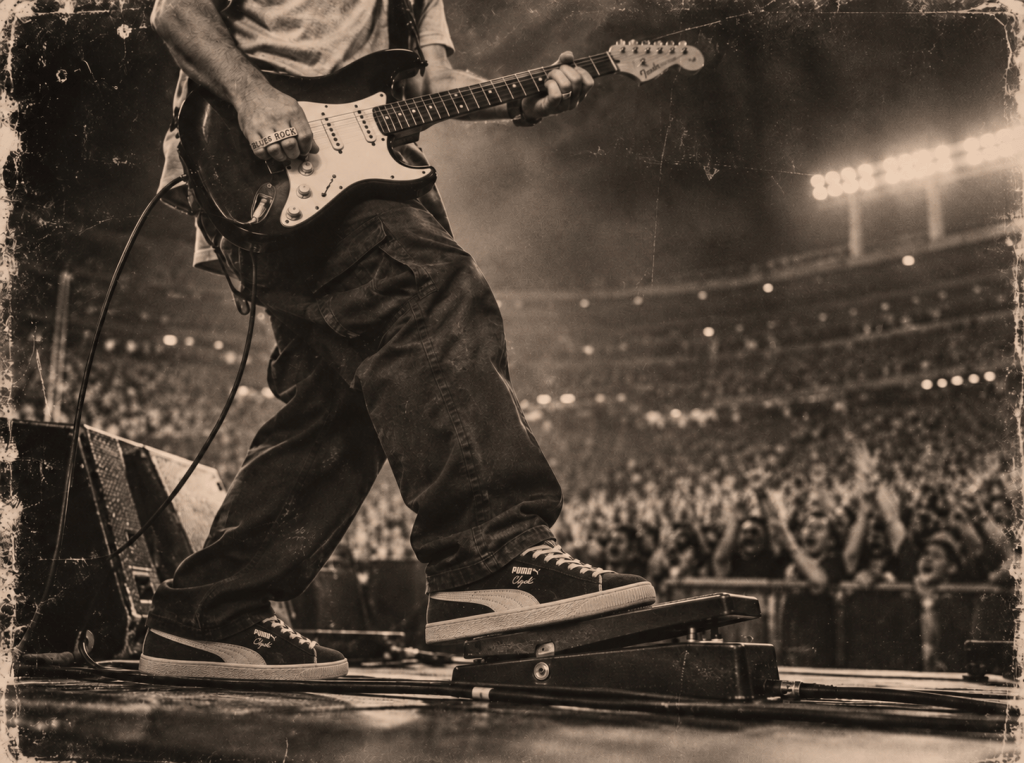
One of the easiest ways to misunderstand Adam “Ad-Rock” Horovitz’s guitar playing on Check Your Head is to judge it by the standards normally applied to rock guitarists.
There are no Eddie Van Halen moments. No long solos. No attempt to prove that Horovitz had spent the previous five years practicing scales. In fact, much of what makes his playing so effective is the opposite. Notes are clipped short. Chords arrive as sudden bursts. Wah-wah lines appear for a few seconds and disappear. Some parts sound crude, slightly sour or almost out of tune. Sometimes the guitar seems less like a guitar than another piece of percussion.
That is precisely why it works.
On Check Your Head, Ad-Rock figured out something that far more technically accomplished guitarists never do: the best guitar part is not necessarily the most impressive part. It is the part the song needs.
And because the Beastie Boys approached playing instruments with the ears of hip-hop producers, Horovitz often seemed to treat his guitar almost like a sample.
Play the interesting two seconds. Then get out of the way.
The Guitar as a Sample
That may be the central idea behind Ad-Rock’s playing on Check Your Head.
The Beasties had just spent years immersed in the microscopic construction of Paul’s Boutique. They knew how powerful a tiny fragment of music could be. A horn hit did not need to develop into a horn solo. A drum break did not need to become an entire song. Sometimes two seconds were enough.
When the group began playing instruments again in Los Angeles, that philosophy did not disappear simply because the sounds were now coming from guitars, basses, drums and keyboards.
Horovitz has specifically named James Brown records, funk, reggae, the Slits, Gang of Four, ESG and the Clash among the music that fed this period. Rather than merely returning to the hardcore punk of the early Beastie Boys, they were trying to play the grooves they had been collecting on records.
Mike D later described part of the Check Your Head idea as essentially making music out of the great break sections of records. That philosophy explains Ad-Rock’s guitar surprisingly well.
He was not always thinking like a conventional rhythm guitarist.
He was thinking like somebody searching for a break.
What Is a Guitar Stab?
Listen carefully to funk records and you will constantly hear what musicians call guitar stabs.
A stab is exactly what the word suggests: a short, sharp burst of guitar.
Instead of strumming a chord and allowing it to ring…
CHAAAAANG…
…the guitarist hits it and immediately stops it.
CHAK.
The fretting hand can release pressure almost immediately after the chord is struck, cutting off the notes. The result is a staccato sound that functions almost as much as percussion as harmony.
In funk, these little chord explosions can be placed between bass notes and drum hits. A guitar that might clutter the arrangement if it played continuously suddenly becomes another rhythmic instrument.
Jimmy Nolen perfected this approach while playing with James Brown. His famous “chicken scratch” technique combined muted strings, short chords and precise sixteenth-note rhythms. Premier Guitar describes Nolen’s playing as foundational to funk guitar and emphasizes how the guitar became a percussive instrument, alternating scratches with clipped chord stabs.
That is an important ancestor of what happens on Check Your Head.
Not because Ad-Rock was trying to impersonate Jimmy Nolen note for note. He wasn’t.
But because he understood the same fundamental principle:
A guitar does not have to fill space. It can create space.
Andy Gill May Be Even More Important
If James Brown supplies one side of Ad-Rock’s guitar vocabulary, Gang of Four supplies another.
This connection is particularly strong because Horovitz himself identified Gang of Four as an influence during the Check Your Head period.
Gang of Four guitarist Andy Gill deliberately rejected conventional rock guitar. His parts were clipped, angular and repetitive, with silence surrounding individual attacks. Gill described the band’s guitar approach as “very staccato, very stripped down, very repetitive, loop-based.”
Read that description again and think about Check Your Head.
Staccato.
Stripped down.
Repetitive.
Loop-based.
That could almost describe the philosophy of Ad-Rock’s guitar playing on parts of the album.
The comparison is especially useful because Gill was not trying to sound like a traditional funk guitarist either. He took funk’s rhythmic ideas and ran them through punk: sharper, uglier, more confrontational.
Ad-Rock was operating somewhere in the same territory.
His guitar could groove without becoming polished funk. It could be punk without simply becoming three distorted power chords. And because it was surrounded by MCA’s bass, Mike D’s drums and Money Mark’s keyboards, Horovitz often had no reason to play anything more.
The Slits: Another Clue
Horovitz also specifically cited the Slits’ Cut as important. That reference tells us something else about his guitar philosophy.
Slits guitarist Viv Albertine has explained that her playing was deeply influenced by reggae. She described using very short, thin, offbeat rhythmic guitar stabs, and has specifically cited Steve Cropper of Booker T. & the M.G.’s as another model for that economical approach.
Even more revealing is Albertine’s philosophy about technique. She has said that she never wanted guitar breaks to become displays of virtuosity. They had to be necessary to the song.
That could almost be Ad-Rock’s mission statement on Check Your Head.
The connection does not mean Horovitz copied Albertine. It means the Beasties were listening to musicians who had already rejected the assumption that becoming a “better” guitarist meant playing more notes.
Sometimes becoming better meant learning which notes not to play.
What Does a Wah-Wah Pedal Actually Do?
Then there is the wah.
The wah-wah pedal is one of the defining sounds of funk guitar. Instead of simply making a guitar louder or more distorted, the pedal changes which frequencies are emphasized.
The guitarist rocks the pedal forward and backward with his foot. As the frequency emphasis moves through the guitar’s sound, the instrument develops a vocal quality:
wah… wah… wah…
Heel down generally produces a darker sound. Rocking forward emphasizes brighter frequencies. Move it rhythmically while playing and an ordinary guitar line begins almost to speak.
The first commercially available wah pedals appeared in the 1960s. Jimi Hendrix and Eric Clapton helped establish the sound in rock, while funk and soul musicians transformed wah into a rhythmic device. Dunlop, which later became the manufacturer most closely associated with the Cry Baby wah, describes the effect in terms of its vocal-like and expressive frequency sweep.
Ad-Rock eventually used a Dunlop Cry Baby live, although I have not found sufficiently reliable documentation establishing the exact model of wah pedal used during the Check Your Head recording sessions. The sound itself, however, is unmistakably part of his vocabulary.
And nowhere is his understanding of it clearer than “Gratitude.”
“Gratitude”: Two Notes Are Enough
“Gratitude” should be studied by anyone trying to understand Ad-Rock as a guitarist.
MCA’s enormous fuzz bass is the foundation. Mike D supplies the groove. Money Mark provides organ. Ad-Rock sings.
And when the guitar gets its moment?
Horovitz basically plays a two-note solo.
Two notes.
A detailed track analysis of “Gratitude” describes exactly that: Ad-Rock plays an extremely simple two-note guitar figure, then works the wah pedal to give those notes their character. Afterward, the guitar drops out and Money Mark’s organ takes over.
That decision tells you more about Horovitz’s musicianship than a thirty-second technical solo would have.
The wah creates movement without requiring more notes.
Instead of:
Watch what I can play.
the guitar says:
Listen to what this song needs right here.
Then it leaves.
That is arrangement.
“So What’Cha Want”: Dischordant in Exactly the Right Way
And then there is “So What’Cha Want.”
This may be the ultimate example of Ad-Rock’s anti-virtuoso guitar philosophy.
The Beasties sound like they initially worked from Southside Movement’s “I’ve Been Watching You,” but ultimately recreated much of the groove themselves. A recent breakdown of the multitrack describes an Ad-Rock overdub as a “nasty little guitar part” in which virtually everything comes from attitude rather than complexity. The guitar and bass are heavily overdriven, and at another point Horovitz produces an abrasive guitar squeal.
That is exactly right.
The guitar sounds wrong in all the right ways.
It is distorted.
It is crude.
Its intonation can sound slightly sour and unstable.
It seems to scrape against Money Mark’s swampy Hammond organ rather than neatly sitting on top of it.
I would be cautious about writing that Ad-Rock’s guitar was definitively recorded literally “out of tune,” because I have not found a reliable primary source confirming that the instrument itself was intentionally detuned. But describing the part as out-of-tune-sounding captures something real about the record. Its roughness, bends, distortion and deliberately unpolished attack keep it from sounding clinically correct.
And So What’Cha Want would almost certainly be worse if that guitar sounded perfect.
Imagine replacing Ad-Rock with a session guitarist.
Perfect tuning.
Perfect intonation.
Cleanly executed chords.
Tasteful solo.
It would destroy the song.
“So What’Cha Want” needs something that sounds as if it might fall apart.
Because the entire record is built around controlled instability: distorted karaoke microphones, filthy bass, overloaded sounds, Hammond organ, strange noises and three rappers almost fighting their way through the mix.
A pristine guitar would be the wrong instrument for that world.
Ad-Rock’s imperfect guitar belongs there.
He Wasn’t Trying to Become a Guitar Hero
The Beastie Boys were refreshingly aware of their limitations as instrumentalists.
Horovitz later summarized their early return to playing instruments by saying that they initially “sucked really bad” but eventually discovered a way to play that worked for them.
That last part matters. They did not need to become another band.
Mike D did not have to become Neil Peart. MCA did not have to become Jaco Pastorius. And Ad-Rock did not have to become Jimmy Page.
They had spent years developing extraordinary ears through hip-hop. They understood grooves. They understood breaks. They understood texture. They understood how one strange sound could transform a record.
So instead of approaching guitar with the question: What should a guitarist play here?
Ad-Rock seems to have approached it with a producer’s question: What sound is missing?
Sometimes the answer was a wah-wah scratch.
Sometimes it was a chord stab.
Sometimes it was feedback.
Sometimes it was two notes.
And sometimes it was nothing.
The Possible Guitar Family Tree
If we draw a stylistic family tree around Ad-Rock’s Check Your Head guitar playing, several names make particular sense.
Jimmy Nolen and the James Brown guitarists provide the clipped, percussive funk vocabulary. Steve Cropper represents the economy of soul guitar, where a tiny rhythmic figure can define an entire recording. Viv Albertine and the Slits show how reggae guitar could be filtered through punk and deliberately primitive musicianship. Andy Gill shows how funk rhythms could become angular, abrasive and almost anti-rock. Mick Jones and Joe Strummer represent the larger Clash philosophy that the Beasties themselves admired: punk musicians did not have to remain trapped inside a single genre.
The important distinction is that not every one of those players can be documented as a direct personal guitar influence on Horovitz. James Brown, the Slits, Gang of Four and the Clash can be tied directly to music Horovitz has identified as important. Jimmy Nolen, Cropper and the individual guitarists provide the musical lineage behind those sounds.
And that lineage leads straight toward the strangely economical guitar playing heard throughout Check Your Head.
The Genius Is in What He Doesn’t Play
There is a beautiful irony here.
On the album where the Beastie Boys proved they could play instruments again, Ad-Rock’s greatest achievement may have been refusing to make the guitar the center of attention.
He allows MCA’s bass to dominate “Gratitude.” He allows Money Mark’s organ to dominate huge portions of the record. He allows Mike D’s drums to define the pocket.
The guitar darts around those instruments. Hit. Silence. Wah. Silence. Scratch. Silence. Ugly little squeal. Gone.
And perhaps that is why Ad-Rock’s playing has aged so well.
Virtuosity can date a record because virtuosity often belongs to a particular era’s idea of what impressive playing should sound like.
A great groove does not.
A perfectly placed sound does not.
Thirty-plus years later, nobody listens to “So What’Cha Want” and wishes Ad-Rock had played twelve more notes.
The quirky little guitar part is already exactly right.
And that may be the highest compliment you can give a guitarist.

